Oxford University Press emails me to say that they will not be publishing Sex Matters: Essays in Gender-Critical Philosophy, despite the fact the book was under contract and had been positively reviewed. (The matter was ultimately resolved and the book is due to be published in July 2023). Alex Byrne describes our experiences with OUP…

Holly Lawford-Smith

Philosophy Compass rejects a paper written by Kate Phelan & I after it has been commissioned, peer-reviewed, and revised. (The paper is about women-only spaces).


Just recently, the International Swimming Federation (FINA) and the International Rugby League (IRL) have announced that transgender athletes are barred from competing against others that share their assigned gender.What does this mean for the fairness of sport, and the authenticity of a woman? Holly Lawford-Smith, an associate professor in Political Philosophy at the University…

Kate & Holly talk to special guest Lierre Keith about Andrea Dworkin's (2000) book Scapegoat.
[This was a letter to Rebecca Solnit, originally hosted on the platform Letter (soon closing). Rebecca declined the invitation to reply].Letter 1 | Holly Lawford-Smith | 12th August 2020Dear Rebecca,I read your piece in The Guardian on Monday. Initially I didn't think it would be relevant to me, given that you addressed…
[This was an exchange with Michael Hauskeller, originally hosted on the platform Letter (soon closing). There's a more scholarly version of our exchange now published in Michael's book The Things That Really Matter (UCL Press, 2022), which is available for free download here.]Letter 1 | Michael Hauskeller | 1st September 2020Dear Holly, …

The expectation used to be that men would be masculine and women would be feminine, and this was assumed to come naturally to them in virtue of their biology. That orthodoxy persists today in many parts of society. On this view, sex is gender and gender is sex.A new view of gender has emerged…

Do transgender women belong in women’s sports? On Gender Games, we hear from transwomen and female athletes about inclusion, fairness and safety. Can sports be inclusive and fair? Or do we need clearer laws to protect women’s sports?
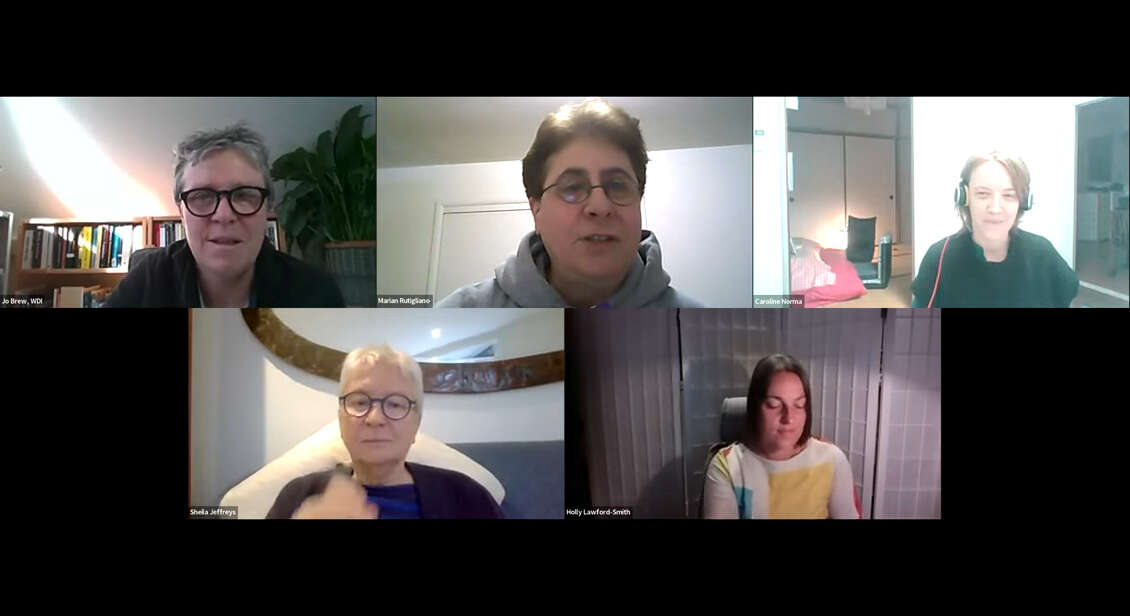
Students at the University of Reading attempt to have my talk at the School of Law (where I am a Visiting Research Fellow) cancelled by the university. (They do not succeed). They protest outside the talk venue. There’s a write-up about it here.
Members of the OUP USA Guild, and ‘members of the international scholarly community with a relationship… to Oxford University Press‘ have both written Open Letters / Petitions to OUP in response to them publishing my book Gender-Critical Feminism.There are posts about these letters on philosophy’s disciplinary blogs here and here, and there’s a clever…
This is a talk about Sarah Lucia Hoagland's book 'Lesbian Ethics: Toward New Value' (1988), which I prepared for an International Women's Day event in Melbourne, Australia in March 2022.ReferencesFrye, Marilyn. ‘Review: A Response to “Lesbian Ethics”’, Hypatia 5/3 (1990), pp. 132-137. Hoagland, Sarah Lucia. Lesbian Ethics: Toward New Value (Palo Alto: Institute…
Holly Lawford-Smith presenting on the Tasmanian Law Reform Institute's 'Issues Paper No. 31', which reviews the empirical literature on conversion therapy.
Holly Lawford-Smith takes on the claim that there's no conflict of interest between gender identity activism and other minority groups, and argues that gender identity activists are engaged in cultural appropriation of a core feminist concept, namely 'gender'.

Associate Professor Holly Lawford-Smith presenting Gender Identity Propaganda at the Coalition for Biological Reality's public event, Gender Identity in Law.[Note: there's a re-recording of my segment here].
This is a re-recording of my talk from the public event 'Gender Identity in Law', held in Hobart, Tasmania on the 26th of February 2022.
Dr Holly Lawford-Smith, radical feminist and associate professor in Political Philosophy at the University of Melbourne, reads her philosophical essay, "Ending Sex-Based Oppression: Transitional Pathways" arguing for the abolition of gender stereotypes, sometimes also referred to as sex roles. First published in Philosophia in November 2020.Abstract: From a radical feminist perspective, gender is a…
